It’s 2018 – Admissions Year

Welcome to Dr.Paul Lowe’s Admissions Expert Blog – 2018

Parents and students are constantly in the throes of the journey for:

  • Private School Admissions:  The application deadline for the top and competitive day and boarding schools is January 15th.
  • College Admissions:  Early decision and action acceptances, rejection and deferred notices have been sent to students.  It’s time for high school seniors to think about what to do next regarding post-decision strategies.  Final decisions: March -April.  For high school juniors, you’ll be hearing from colleges in 12 months!
  • Transfer Admissions:  Most applications are due in March.  Therefore, it’s time to complete applications and most importantly it’s time to complete those personal statements.
  • BS/MD Admissions:  Competition for coveted spots is heightened based on the increased number of applicants last year which was reflected by the number of rejected applicants.
  • Medical School Admissions: College juniors should begin to draft their personal statements, schedule to take their MCATs no later than May and obtain letter of recommendations.
  • Law School Admissions:  Senior year – If you’re still in college, have your college Registrar submit updated transcript that reflects your Fall semester grades and
  • Graduate School Admissions:  Junior year – Start your search on graduate school programs. Once you have conducted your thorough searches for prospective institutions, make an alphabetical list of between 10 and 20 programs, regardless of what you presently know or have heard about them. Write them all down or put them on a spreadsheet.

Each year, admissions policies and strategies change, so stay tuned for my upcoming, informative, helpful and thought-provoking admissions blogs!

Dr. Paul Lowe, founder and managing director of Pinnacle Educational Center Admissions Advisors Group, provides comprehensive counseling advice, exclusively for admissions to top private schools; Ivy League and highly-selective colleges/universities; BS/MD programs;  graduate and medical schools and top visual and performing arts programs.  He also specializes in helping students who have been wait-listed, deferred or rejected gain admission into their top-choice schools.

2017 College Admissions Trends in Review

The National Association for College Admission Counseling in association with the US Department of Education and the Higher Education Research Institute developed a report that reflects trends college admissions in 2017.

Here are some of the highlights of trends in 2017 that you may need to follow in 2018:

  • Number of Applications per Student:  The increase in number of colleges to which each student applies continues a nearly perfect upward trend.
  • Application Volume:  There was continued growth in college application volume in 2017.   The number of applications from firs-time freshmen and international students increased.
  • Top factors in admissions offices decisions:  The most important were grades in college preparatory courses, overall high school GPA, admission test scores and strength of curriculum.  Among the next most important factors were the college essay, counselor and teacher recommendations, extracurricular activities and class rank.
  • Student-Counselor Ratios:  The average student-to-counselor ratio was 281-to-1.  The number exceeds the 250-to-1 maximum ration recommended by the American School Counselor Association.
  • Postsecondary/college admissions counseling by school counselors: On average, the time that counselors spend on postsecondary/college admissions counseling: 21 percent.
  • Early Decision and Early Action Activity:  There is an increase in the  number of applicants applying Early Decision and Early Action.
  • International Applicants:  A greater proportion of colleges rated the essay/writing sample as considerably important for international applicants, likely because of the additional confirmation of English skills that the essay provides.

Knowing and understanding past college admissions trends will be helpful for high school juniors (class of 2019) when they are in the throes of the college admissions process.  Trends help us (Pinnacle Educational Center Admissions Advisors Group) to develop and implement admissions strategies so that our clients are accepted to their top choice colleges and universities!

Dr. Paul Lowe is the managing director of Pinnacle Educational Center Admissions Advisors Group network.  He and his team of admissions advisors, through the admissions affiliate, Ivy League Admissions Advisors help students gain admissions to ivy League and highly selective colleges and universities.  Through his admissions affiliate:  College Application Rejected, he specializes in  helping students who have been rejected deferred, or waitlisted.  For college students who wish to transfer because they desire a better college or they simply dislike their current college: College Transfer Admissions Advisors.

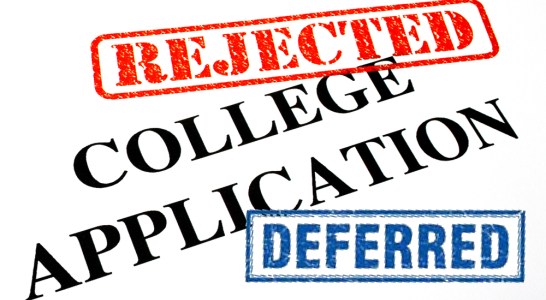
What If You Are Rejected or Deferred Early Action/Decision?

As the early decision results come flooding in there is a mixture of feelings in the air. While some happy students settle in for the holidays with their acceptance letters in hand, others will be disappointed and stressed in discovering that they have been deferred to regular decision or, worse-case scenario, rejected. For those who are deferred, their applications will be re-considered along with the thousands of Regular Decision applicants. In the Regular Decision pool, the selection process becomes even more competitive and selective. The likelihood of acceptance is even lower.

Many students try the strategy of applying to what they perceived to be safety schools because they think the school will likely accept them early, only to discover that they are deferred or rejected. In either case, deferral or rejection, SOMETHING WENT WRONG. The problem is that the application errors that caused the rejection or deferral, if not discovered, will continue without rectification to the regular decision pool and result in multiple rejections.

With only a few weeks left in the application season, I recommend that students scrupulously reevaluate their deferred or rejected early/action application and carefully plan a workable strategy in this crunch-time.  (1) Prepare more applications.  (2) In the case of deferral, see what else the college might need.  (3) In the case of rejection, especially if this was your safety (non-reach school), you seriously need to review your application.  (4) In all cases, you may need to hire an educational consultant who is an expert in post-decision admissions advising.

For parents who engage our services after the disheartening news of deferral or rejection, I use our post-decision strategies.  I discover what the student did to be rejected or deferred, build upon their current student profile and accomplishments and re-energize their application so that they are removed from the deferred list and placed on to the accepted list.  Additionally, I assess the student’s Regular Decision applications (due by January 1) to identify mistakes on their Early Decision application so that their mistakes do not become viral and affect the student’s Regular Decision applications.

The worst thing a student can do is to settle for a safety school after all their hard work and find themselves (and their parents) in this unhappy situation of being rejected from their dream schools and reach schools.


Dr. Paul Lowe is the manager director of Pinnacle Educational Center Admissions Advisors Group network.  He and his team of admissions advisors, through the admissions affiliate, Ivy League Admissions Advisors, help students gain admissions to Ivy League and highly selective colleges and universities.  Through his admissions affiliate:  College Application Rejected, he specializes in helping students who have been rejected, deferred or waitlisted.

The Changing Landscape of College Admissions

For years, elite colleges have tried to address a proportional decline of students arriving from areas beyond metropolitan and suburban areas.  These colleges have been implementing additional measures to address diversity issues on college campuses.  Increasingly, private elite colleges are seeking small-town and rural students.

One thing has not changed with regard to college admissions and diversity.  Recent studies by the National Center for Education Statistics have shown that even with Affirmative Action policies, Black and Latino students are more underrepresented at these colleges and the percentages of students in these schools have remained flat over the last 35 years.  The only increase in percentage of students by race are Asian students.

Research studies have shown admissions biases against rural students with financial needs; and found that leadership roles popular in rural communities, such as 4H clubs, Future Farmers of America and ROTC worked against the students who claimed them on applications.  As a result of the decrease in students from low-income and working-class white families from rural areas, colleges are now increasing their admissions effort to recruit these students.

What are some of the elite and selective colleges doing to address these issues?  Swarthmore has a created a program called Small Town Swarthmore.  Princeton has increased their recruitment efforts through transfer programs from community colleges to help students from rural backgrounds.

Colleges want U.S. geographical diversity, not just students predominantly from metropolitan and suburban areas.  As schools implement their plans to increase diversity in their incoming classes based on small town and rural students (as well as Black, Latino and Indigenous students), expect to see a change in demographics on elite college campuses that properly reflects the true diversity throughout the U.S. population.

Dr. Paul Lowe is the managing director of Pinnacle Educational Center Admissions Advisors Group network.  He and his team of admissions advisors, through the admissions affiliate, Ivy League Admissions Advisors help students gain admissions to Ivy League and highly selective colleges and universities.  Through his admissions affiliate:  College Application Rejected, he specializes in helping students who have been rejected, deferred or waitlisted.

Winter College Planning Checklist for High School Juniors – 2017

college planning checklist

It’s still fall, but it’s not too early for high school juniors to continue (or for some to start seriously planning) for the competitive college admissions process.

There are lots of things to do during the winter months.

  1. Prepare for SAT/ACT.
  2. Consider taking SAT-Subject Tests
  3. Plan to take AP exams in May.
  4. Plan to visit colleges
  5. Refine your choices of colleges by comparing and contrasting schools and attending college fairs.
  6. Review and assess where you stand academically.
  7. Plan your senior schedule based on your current course performance.
  8. Review, assess and take inventory of your accomplishments, activities and work experiences.
  9. Plan your summer activities.

——————————————————————————————————————

Dr. Paul Reginald Lowe is the managing director and lead admissions expert at Pinnacle Educational Center Admissions Advisors Group.  Dr. Lowe specializes in providing exclusive concierge-type admissions advisory services for U.S. and international families and students who are interested in applying to Ivy League and highly selective colleges and combined BS/MD programs.  Dr. Lowe also helps students gain admissions into their top choice private schools and colleges after they have been deferred, wait-listed and rejected.

As an experienced and trusted admissions advisor for over 20 years, Dr. Paul R. Lowe is an active member of the following organizations that uphold the ethical and professional standards and principles of good admission practices in college and independent school counseling: Higher Education Consultants Association (HECA), National Association for College Admissions Counseling (NACAC), New Jersey Association for College Admission Counseling (NJACAC), New York State Association for College Admissions Counseling (NYSACAC) and International Association for College Admissions Counseling (IACAC).

Top Colleges and Student Debt

College Financial Aid

Many expensive private non-profit four-year colleges try to keep student borrowing low by giving generous financial aid to undergraduates from lower-income families.  Among highly selective private non-profit colleges, Harvard University was the most successful in keeping federal student-loan debt low for its graduates who took out such loans.  Six Ivy League schools, including Harvard, were among the top 25 on that measure. The list below shows a school and the median debt for its graduates.

1.  Harvard U. – $6,500

2.  Duke U. – $7,500 | Princeton U. – $7,500

4.  Rice U. – $10,228

5.  Pomona College – $11,000

6.  Piedmont International U. – $11,326

7.  Cornell U. – $12,000

8.  Stanford U. – $12,475

9.  Amherst College – $12,975

10.  Haverford College – $13,000

11.  Grinnell College – $13,170

12.  Dartmouth College – $13,462

13.  Yale U. – $13,500

14.  Vanderbilt U. – $14,000

15.  California Institute of Technology – $14,350

16.  Bates College – $14,450

17.  U. of Chicago – $14,500

18.  Williams College – $14,583

19.  Franklin W. Olin College of Engineering – $14,710

20.  Claremont McKenna College – $14,968

21.  Brown U. – $15,000 | John Hopkins U. – $15,000

23.  Georgetown U. – $15,500

24.  Hamilton College (NY) – $15,760

25.  Middlebury College – $15,889

Source:  U.S. Department of Education, National Student Loan Data System

Keep this in mind as you make your plans for college admissions!

—————————————————————————————————————

Dr. Paul Reginald Lowe is the managing director of Pinnacle Educational Center Admissions Advisors Group network. He and his team of admissions advisors, through the admissions affiliate, Ivy League Admissions Advisors help students gain admissions to Ivy League and high selective colleges and universities. 

What College Athletic Coaches Are Looking For When Recruiting (Part 3)

Part 3 of a 3-part series.  

You’ve been playing your sport for 5-10 years and you want to be recruited or at best recruited and receive that four year athletic scholarship from your top choice college. Don’t sell yourself short.

My advice after over 20 years in the college admission business and constantly talking college coaches and Athletic Directors are these additional points college coaches are looking for:

  1. Coach Ability: Coaches want someone who wants to be coached. They don’t want someone who questions what they do and insists on doing something else. A coach has a program in which they have developed an elite team; they want someone willing to fit into that mix.
  2. The WOW Factor: What’s your personal athletic “wow factor” that makes you stand out and get recruited. What do I view as a your “wow factor”?  Your charisma, confidence, motivation, initial-impression, appearance, communication skills, attitude, self-esteem, authenticity, presence, harmony and vibe.  What personal characteristic is truly unique, captivating and exciting about you? And how will you contribute and or passively transfer these characteristics to teammates, to your class and to professors.   It’s a factor that coaches look for as well as discuss with the admissions committee as to the reason why they want you at their school on and off the team.

See Part 1 – Points: 1-3 and Part 2 – Points: 4-6.

—————————————————————————————————————

Wall Street Journal/Times Higher Education College Ranking 2017

College Ranking

The Wall Street Journal/Times Higher Education Ranking 2017 was just released.  The rankings emphasize how well a college will prepare students for life after graduation.  The overall ranking is based on 15 factors across four areas:  Outcomes, Resources, Engagement and Environment.   Each school’s overall score is determined by student outcomes (including a measure of graduate salaries), the school’s academic resources, how well it engages students and from the diversity of the students and staff.

THE TOP TEN:  Schools that achieved the highest overall scores in the ranking:

1.  Harvard

2.  Columbia University

3.  Massachusetts Institute of Technology | Stanford University

5.  Duke University

6.  Yale University

7.  California Institute of Technology

8.  University of Pennsylvania

9.  Princeton University

10  Cornell University

——————————————————————————————————————————

Dr. Paul Reginald Lowe is the managing director of Pinnacle Educational Center Admissions Advisors Group network. He and his team of admissions advisors, through the admissions affiliate, Ivy League Admissions Advisors help students gain admissions to Ivy League and high selective colleges and universities. 

College Admissions: The Need to Read

You may ask yourself, why is a college admissions advisor writing about reading?  What does reading have to do with college admissions?  Everything!  One of the first things I ask my clients is what do you like to read outside the required reading at school.  Even the best students have difficulty answering this question.  Why is the need to reed important in the college admissions planning process?  I just provided an example!  There are several other reasons, a few of which are described below.

  1. Common Application supplements, especially ones for the more competitive institutions, ask what types of books have you read or what books influence you. Types of books also demonstrate another character dimension of applicants by which the admissions committee might judge you.  It tells the committee your interests, your passions and most importantly that you are doing something other than the norm, for example, not reading.  Remember, admissions officers read your applications.
  2. Reading helps you to improve your written communication and speech skills. This, of course, will be helpful during college interviews. Remember to use the word “like” as a verb or in a simile, and not as a filler in a spoken sentence.  One admissions officer told me that excessive use of “like” in a conversation is “Valley speak” and sounds cartoonish.   Reading helps you to master the English language, obviating the need to use unnecessary fillers.
  3. Studies show that there is a strong correlation between reading and a student’s ability to grasp math, science and abstract concepts, apply logic in various scenarios, recognize cause and effect, and utilize good judgment. This may translate to better academic performance and even higher standardized test scores.  Most importantly, reading contributes to the possibility of one’s success in all endeavors.
  4. Research has found that when students read extensively they become better writers. Reading a variety of genres helps students learn text structures, language usage and vocabulary that they can then incorporate to their own communication styles.   How does this relate to college admissions?  As you master the English language, you will have less difficulty completing the personal statement and supplemental essays on the Common Application.  You will also express your ideas succinctly, accurately, and convincingly to admissions committees.  When we review our clients’ Common Applications and supplemental essays, we can tell who are the avid bibliophiles.

So as you sea, there is a need to rede. Buy the way, “rede” and “reed” were spelled properly.  They are homonyms of read (four those of ewe who use “spell check” for proofreading yore essays).  Rising seniors, who are filling out their Common Applications, bee careful.

“Reading is to the mind as exercise is to the body.   It is wholesome and bracing for the mind to have its faculties kept on the stretch”…Sir Richard Steele

—————————————————————————————————————————-

Dr. Paul Reginald Lowe is the managing director of Pinnacle Educational Center Admissions Advisors Group network. He and his team of admissions advisors, through the admissions affiliate, Ivy League Admissions Advisors help students gain admissions to Ivy League and high selective colleges and universities. 

7 Huge Mistakes Parents Make in BS/MD Admissions

“Going it alone” in this vast arena of BS/MD admissions can result in mistakes, as applicants are easily blindsided by obstacles and pitfalls that they don’t even know exist. When parents call our office to provide initial information, as I listen to their children’s BS/MD program profile I can almost predict (using trends, predictive analysis and real-time insider perspective of the BS/MD programs) that their child will be REJECTED based on the sameness of their profile.  Yet when I explain to parents that their children sound exactly like other applicants they are in total disbelief.  I have concluded that the children are merely following the advice of their parents and the parents are making costly mistakes. Try to avoid these common errors:

  1. Parental Hubris:  Many parents assume that their skill sets, professional title or socio-economic status and connections can help their children get accepted in the coveted BS/MD spots.  This is a huge mistake!  Their professional skills sets are helpful in finance, medicine, business, technology or research, but when it comes to BS/MD admissions they should leave it to experts who are involved and understand the ever-changing BS/MD admissions process.  The inability to admit that they don’t know what they don’t know could result in REJECTION!
  2. Group Think:  Many parents read the same websites, same books, and talk with the same people in their respective communities, personal and professional circles.  Most or all of the members of the in-group share an illusion of invulnerability that provides for them some degree of reassurance despite obvious dangers and leads them to become overly-optimistic.  Thinking in a group discourages creativity and non-conformity, resulting in everyone appearing the same on paper.  It causes them to fail to respond to obvious and clear admissions mine fields.  As a group, faulty (and sometime irrational decisions and admissions strategies) are reinforced. The result:  increased probability as a group of REJECTION.
  3. Not understanding or accepting demographics:  Many of my clients are of Asian descent (Chinese, Indian, Korean, Filipino and Japanese).  This population, as a group, has been responsible for an increase in applicants by 30% to BS/MD program.  Many parents may not be aware of the increased numbers.  Colleges and their BS/MD programs desire classes that are diverse and demographically reflective of the general population.  No matter which admissions method is used (team approach, character assessment or holistic approach), schools will not accept more of one demographic just because of an increase in the number of applications.  The competition becomes hyper-competitive within a particular demographic.
  4. Procrastination: The BS/MD admissions journey begins in high school freshman year, not during the fall of a student’s senior year.  (See: BSMD Programs – Getting In!)  From time to time parents will call us regarding a high school senior in September or October of their senior year requesting help for BS/MD programs.  It may be difficult to undue mistakes that will result in rejection, although not impossible.  But generally, these parents assume that they have done everything right and are calling to see if they can obtain free advice.  Unfortunately, as they discuss their child’s achievements I can almost predict their student profile.  By procrastinating, they have inadvertently increased the probability of REJECTION.
  5. Misunderstanding Investment vs. Cost:  What’s your child’s future worth?  According to the US Department of Agriculture, the cost of raising a child for a middle-income family born in 2001-2003 through the age of 18, not including college costs is $224,000 to $227,000 for middle income families and $327,000 to $330,000 for higher incomes.  This does not include private school tuition, summer athletic or music camps, or specialized college summer camps.  When a parent calls us to ask “the price” of our BS/MD admissions advisory services for the purpose of negotiating for the cheapest rate, we can already predict the probability of REJECTION.  Consider the worthy investment in your child’s future.
  6. Seeking Advice from the Wrong Advisor: (a) Guidance counselors – public school guidance counselors only spend 26% of their time on college admissions and the average counselor-to-student ratio is 1:250.  Guidance counselors don’t have the expertise in BS/MD program admissions.  (b) Advisors who are journalist or writers who never attended medical school nor understand the highly selective process – no expertise in BS/MD program admissions.  (c) Advisors who advise part-time – self explanatory. There is a major difference between useful knowledge and information.  Parents should hire an advisor who is a full-time admissions advisor who actually visits colleges, BS/MD programs and medical schools, understands BS/MD programs of the various schools, and has insightful knowledge of each program.  “If you don’t know where you’re going you’ll end up somewhere else” – Yogi Berra
  7. Parents want the best for their children.  They read as much as possible, network with others in schools and educational programs, provide extensive extracurricular educational opportunities for their children, research on the web about BS/MD programs…..but somehow when they are just along the last stretch to the finish line they make egregious, irrevocable and calculated mistakes that cause their children to be rejected.  Don’t make these mistakes!

————————————————————————————————————————————-

Dr. Paul Reginald Lowe is the managing director of Pinnacle Educational Center Admissions Advisors Group network. He and his team of admissions advisors, through the admissions affiliate, BS/MD Admissions Advisors, help high school students get accepted to BS/MD programs.