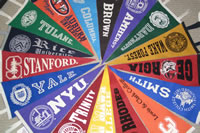
Does It Matter Where You Attend College? Absolutely!

Does it matter where you attend college

I often hear from parents, students, high school guidance counselors and even fellow educational consultants that it doesn’t matter where you attend college, as long as where you attend is a “good fit”.  Actually studies show it does matter where you attend college! My recommendation to my U.S. as well as international clients is that one should attend the “best” school possible where you will happy and have a great and memorable college experience.

Obviously, there are many people who are happy, quite successful and have had wonderful college experiences without attending Ivy League or highly competitive colleges.  However, in this tight job market, recent college graduates increasingly find that higher paying jobs are very selective.  While attending an Ivy League or selective college may not guarantee financial success or happiness, to buyers of talent (HR professionals, employers, personnel departments) it certainly does matter.  One of the first questions they consider while perusing a job applicant’s resume: where did you attend school?

  1. A study in the journal, Research in Social Stratification and Mobility, confirms parental suspicions that the best route to a top job is to attend an Ivy League school. According to Dr. Lauren Rivera, the author of the study, “Elite professional service employers rely more on academic pedigree more than any other factor.  Where you went to school rather than what you did there makes the difference”.
  2. PayScale Inc., an online provider of global compensation data, in a survey demonstrated that an Ivy League diploma is still worth its price of admission and tuition. “An Ivy League education makes a job candidate stand out, even before a recruiter talks to them!  The median starting salary for Ivy Leaguers is 32% higher than that of liberal-arts college graduates and at 10 or more years into graduates’ working lives, the spread is 34%.”
  3. Robert H. Frank, an economics professor at the Johnson Graduate School of Management at Cornell University, stated: “Because of the bitter competition for premium salaries, elite educational credentials are often a precondition for even landing a job interview.  Degrees from elite schools clearly open doors.”
  4. In The Economist that there is a direct correlation between education, the inheritance of privilege and class. According to an extensive report in The Economist: “For those at the top of the pile, moving straight from the best universities into the best jobs. the potential rewards are greater.”
  5. Top 20 universities producing billionaires is dominated by blue-chip, elite U.S. institutions.  Billionaires are likely to have attended some of the traditionally most prestigious universities.  Top universities have become the place where “global players gather”.  Educational insights from an annual profile of the uber-rich – Wealth-X and UBS Billionaire Census.

Let’s face it.  We live in a competitive, meritocratic and global society where brand, image, prestige and reputation certainly matter.  The answer to the question: does it matter where you attend school, then, is rhetorical.  Still believe it doesn’t matter? Just ask the record number of students (an estimated 30,000) who apply every year to each Ivy League school where the rejection rates can exceed 90% for these colleges.

—————————————————————————————————————————

Dr. Paul Reginald Lowe is the managing director of Pinnacle Educational Center Admissions Advisors Group network. He and his team of admissions advisors, through the admissions affiliate, Ivy League Admissions Advisors help students gain admissions to Ivy League and high selective colleges and universities. 
BS/MD Programs: Getting In!

Top BS/MD Programs

As an admissions advisor, I have been successfully helping high school students get accepted to BS/MD programs for over 20 years.  Year after year, nervous parents call or e-mail us wanting to know what’s needed for their children to be accepted.  The parents have planned ahead since as far back as middle school (and sometimes even elementary school), reading books, visiting websites, and even e-mailing multiple consultants (including yours truly) to see if they can obtain an ounce of free advice to help their children.

Getting in is not just about:

  • Having a high GPA.
  • Loading up on many AP classes.
  • Getting high SAT or ACT scores.
  • Taking advice from your high school or college counselor.
  • Reading “How To” books or guides on BS MD programs.
  • Shadowing doctors.
  • Starting a philanthropic club or foundation.

There is much more involved in this competitive process.

Firstly, schools want to know, through your essay and recommendations, that you truly desire to be a doctor.  After all, these are very competitive programs and coveted spots.  From my discussions with admissions officers at several of these programs, they can decipher within the first paragraph of the “Why doctor?” essay who does not belong in their program – REJECTION!

Secondly, they certainly will not accept students who sound just like everyone else.  They accept students who stand out and who are unique.  That’s easier said than done when the students and their parents are reading the same material and making the same assumptions to “game” the admissions process.  If parents are all reading the same material, Goggling the same sites, relying on the same resources, they will certainly all sound the same.  When they call our office, parents ( and their children’s profile sound exactly the  same.  As “contrarian admissions specialist”, through hours of talking with my client, I discover and identify some unusual characteristic that will set my client apart from that sameness and get them accepted into BS/MD programs.

Thirdly, BS/MD program admissions officers read between the lines.  After all, they are experts in selectivity!  And in many instances, they may use the team-based approach in reviewing applications.  Ninety-five percent of the applicants are academically qualified.  So the real questions become:  Who is the applicant? What makes them different?  What’s the applicant’s character?  How do they think?   How will they contribute to our college and our program? When my team and I work with our clients, we spend hours reviewing their character and answering the above questions so that they are accepted!

So if your child has great SAT/ACT scores, high GPA, lot’s of AP classes, plays violin, piano, flute; was a member of the local and regional youth orchestra, member of the school marching band or jazz band, received science awards, has an art portfolio, plays tennis, lacrosse, soccer, badminton and was on the swim team, volunteers to help the poor, has an EMT certification, shadowed doctor, authored a paper and started a non-profit, they sound just like every other applicant who is applying to BS/MD programs.

What I do is help our BS/MD program clients find and express their unique qualities in a positive light to insure that they stand out and get ACCEPTED!

————————————————————————————————————————————-

Dr. Paul Reginald Lowe is the managing director of Pinnacle Educational Center Admissions Advisors Group network. He and his team of admissions advisors, through the admissions affiliate, BS/MD Admissions Advisors, help high school students get accepted to BS/MD programs.

College Admissions: How Will Your Character Be Assessed?

The work of selecting students for admissions into colleges and universities is becoming more complex. Each year college admissions officers and their committees review thousands of applications and seek to predict the likelihood of those applicants to meaningfully contribute socially, culturally and personally to their specific college communities.  Ivy League and highly selective colleges use a team review process to holistically evaluate each applicant when creating a particular class during the admissions process.  That means acceptance to these colleges is not based on a simple formula of cognitive measures (grades and test scores).  Instead, admissions officers consider a variety of factors, including the student’s academic record, extracurricular interests, intellectual achievements and personal background, to decide who will be rejected or accepted.

Many college admissions offices are now looking to rely less on cognitive-based measures (standardized tests and grades) and more on character attributes when choosing applicants. They are turning to research showing that a student’s potential for long-term success is predicted less by test scores and more by traits such as optimism, curiosity, resilience, metacognition and adaptability.

College admissions professionals have spent several years determining other character traits that are most important to their respective institutions. When admissions officers have chosen the applicants they plan to present to their admissions committee, the applicants have been determined to have traits such as honesty, resilience, curiosity, perseverance, leadership and the capacity for teamwork.  Traditionally, these character traits are discovered by admissions officers using personal essays, interviews, lists of extracurricular activities, and letters of recommendation to get a holistic view of applicants.  Admissions officers now have other tools for character assessment at their disposal.

For college admissions, character traits tied to an interview, essay answers and letters of recommendation, are just as important and impressive, if not more so as, academic credentials.

I have always advised my clients to consider their character attributes and the holistic approach as they prepare for college admissions. It should now be clear that character assessment is the premier focus for college admissions.

————————————————————————————————————————————-

Dr. Paul Reginald Lowe is the managing director and lead admissions expert at Pinnacle Educational Center Admissions Advisors Group.  Dr. Lowe specializes in providing exclusive concierge-type admissions advisory services for U.S. and international families and students who are interested in applying to Ivy League and highly selective colleges and combined BS/MD programs.  Dr. Lowe also helps students gain admissions into their top choice private schools and colleges after they have been deferred, wait-listed and rejected.

As an experienced and trusted admissions advisor for over 20 years, Dr. Paul R. Lowe is an active member of the following organizations that uphold the ethical and professional standards and principles of good admission practices in college and independent school counseling: Higher Education Consultants Association (HECA), National Association for College Admissions Counseling (NACAC), New Jersey Association for College Admission Counseling (NJACAC), New York State Association for College Admissions Counseling (NYSACAC) and International Association for College Admissions Counseling (IACAC).

Summer College Planning Checklist for Rising High School Juniors

college planning checklist
Happy August!  Are you busy enjoying the summer? Or are you preparing for college admissions as a rising junior?  Use your summer downtime to plan and organize your college admissions journey.
  1. Enroll in an ACT or SAT prep course during the summer while you still have time.
  2. Research and find out test dates for ACT or SAT.
  3. For international students, research and find out test dates for the TOEFL exam.
  4. Visit college campuses to see which types of schools appeal to you.
  5. Begin to develop a preliminary list of colleges.
  6. Continue your participation in internships, camps, research, community service and other activities and see how they fit in your college admissions journey.
  7. Review your online persona.  Examine your information on Facebook, Instagram, Snapchat, Twitter, etc.
  8. Begin to prepare for courses that you have enrolled in for the upcoming school year.

It’s never too early to start planning for college!

————————————————————————————————————————————

Dr. Paul Reginald Lowe is the managing director and lead admissions expert at Pinnacle Educational Center Admissions Advisors Group.  Dr. Lowe specializes in providing exclusive concierge-type admissions advisory services for U.S. and international families and students who are interested in applying to Ivy League and highly selective colleges and combined BS/MD programs.  Dr. Lowe also helps students gain admissions into their top choice private schools and colleges after they have been deferred, wait-listed and rejected.

As an experienced and trusted admissions advisor for over 20 years, Dr. Paul R. Lowe is an active member of the following organizations that uphold the ethical and professional standards and principles of good admission practices in college and independent school counseling: Higher Education Consultants Association (HECA), National Association for College Admissions Counseling (NACAC), New Jersey Association for College Admission Counseling (NJACAC), New York State Association for College Admissions Counseling (NYSACAC) and International Association for College Admissions Counseling (IACAC).